Harm Potential of Magic Mushroom Use a Review Summary
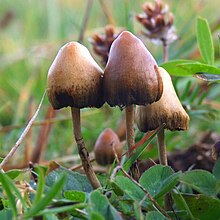
Psilocybin mushrooms; commonly known as magic mushrooms, mushrooms or shrooms, are a polyphyletic informal grouping of fungi that contain psilocybin which turns into psilocin upon ingestion.[1] [two] Biological genera containing psilocybin mushrooms include Copelandia, Gymnopilus, Inocybe, Panaeolus, Pholiotina, Pluteus, and Psilocybe. Psilocybin mushrooms have been and continue to be used in indigenous New World cultures in religious, divinatory, or spiritual contexts.[3] Psilocybin mushrooms are also used as recreational drugs. They may be depicted in Stone Historic period rock art in Africa and Europe, just are nigh famously represented in the Pre-Columbian sculptures and glyphs seen throughout N, Central and Southward America.
History [edit]
Early [edit]
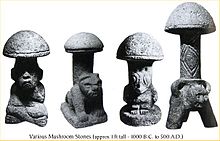
Pre-Columbian mushroom stones
Prehistoric rock arts well-nigh Villar del Humo in Espana, suggests that Psilocybe hispanica was used in religious rituals six,000 years ago.[4] The hallucinogenic[v] species of the Psilocybe genus have a history of use amid the native peoples of Mesoamerica for religious communion, divination, and healing, from pre-Columbian times to the present mean solar day.[half-dozen] Mushroom stones and motifs take been found in Guatemala.[7] A statuette dating from ca. 200 CE. depicting a mushroom strongly resembling Psilocybe mexicana was found in the west Mexican country of Colima in a shaft and sleeping accommodation tomb. A Psilocybe species known to the Aztecs every bit teōnanācatl (literally "divine mushroom": agglutinative form of teōtl (god, sacred) and nanācatl (mushroom) in Nahuatl language) was reportedly served at the coronation of the Aztec ruler Moctezuma 2 in 1502. Aztecs and Mazatecs referred to psilocybin mushrooms equally genius mushrooms, divinatory mushrooms, and wondrous mushrooms, when translated into English language.[8] Bernardino de Sahagún reported the ritualistic utilise of teonanácatl by the Aztecs when he traveled to Central America after the expedition of Hernán Cortés.[ix]
Afterwards the Spanish conquest, Catholic missionaries campaigned against the cultural tradition of the Aztecs, dismissing the Aztecs as idolaters, and the use of hallucinogenic plants and mushrooms, together with other pre-Christian traditions, was apace suppressed.[seven] The Castilian believed the mushroom immune the Aztecs and others to communicate with demons. Despite this history the utilize of teonanácatl has persisted in some remote areas.[3]
Modern [edit]
The first mention of hallucinogenic mushrooms in European medicinal literature was in the London Medical and Physical Journal in 1799: a homo served Psilocybe semilanceata mushrooms he had picked for breakfast in London'south Light-green Park to his family. The apothecary who treated them later described how the youngest child "was attacked with fits of immoderate laughter, nor could the threats of his father or mother refrain him."[10]
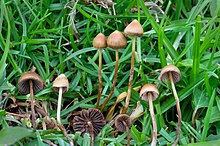
In 1955, Valentina Pavlovna Wasson and R. Gordon Wasson became the first known European Americans to actively participate in an indigenous mushroom ceremony. The Wassons did much to publicize their experience, even publishing an article on their experiences in Life on May 13, 1957.[11] In 1956, Roger Heim identified the psychoactive mushroom the Wassons brought back from Mexico as Psilocybe,[12] and in 1958, Albert Hofmann kickoff identified psilocybin and psilocin as the active compounds in these mushrooms.[thirteen] [xiv]
Inspired by the Wassons' Life article, Timothy Leary traveled to Mexico to experience psilocybin mushrooms himself. When he returned to Harvard in 1960, he and Richard Alpert started the Harvard Psilocybin Project, promoting psychological and religious study of psilocybin and other psychedelic drugs. Alpert and Leary sought out to conduct enquiry with psilocybin on prisoners in the 1960s, testing its effects on recidivism.[15] This experiment reviewed the subjects six months later, and found that the recidivism rate had decreased beyond their expectation, below 40%. This, and another experiment administering psilocybin to graduate divinity students, showed controversy. Shortly after Leary and Alpert were dismissed from their jobs past Harvard in 1963, they turned their attention toward promoting the psychedelic experience to the nascent hippie counterculture.[16]
The popularization of entheogens by the Wassons, Leary, Terence McKenna, Robert Anton Wilson and many others led to an explosion in the use of psilocybin mushrooms throughout the earth. By the early 1970s, many psilocybin mushroom species were described from temperate Northward America, Europe, and Asia and were widely collected. Books describing methods of cultivating large quantities of Psilocybe cubensis were also published. The availability of psilocybin mushrooms from wild and cultivated sources have made them one of the most widely used of the psychedelic drugs.
Now, psilocybin mushroom apply has been reported amongst some groups spanning from primal Mexico to Oaxaca, including groups of Nahua, Mixtecs, Mixe, Mazatecs, Zapotecs, and others.[three] An of import figure of mushroom usage in Mexico was María Sabina,[17] who used native mushrooms, such as Psilocybe mexicana in her practice.
Occurrence [edit]
In a 2000 review on the worldwide distribution of psilocybin mushrooms, Gastón Guzmán and colleagues considered these distributed among the following genera: Psilocybe (116 species), Gymnopilus (xiv), Panaeolus (13), Copelandia (12), Pluteus (six) Inocybe (6), Pholiotina (iv) and Galerina (1).[xviii] Guzmán increased his approximate of the number of psilocybin-containing Psilocybe to 144 species in a 2005 review.

Global distribution of 100+ psychoactive species of genus Psilocybe mushrooms.[nineteen]
Many of them are constitute in Mexico (53 species), with the residual distributed throughout Canada and the U.s. (22), Europe (16), Asia (xv), Africa (four), and Australia and associated islands (19).[20] Mostly, psilocybin-containing species are night-spored, gilled mushrooms that abound in meadows and woods in the subtropics and tropics, usually in soils rich in humus and plant debris.[21] Psilocybin mushrooms occur on all continents, but the majority of species are constitute in subtropical humid forests.[18] P. cubensis is the almost common Psilocybe in tropical areas. P. semilanceata, considered the globe'southward most widely distributed psilocybin mushroom,[22] is found in temperate parts of Europe, North America, Asia, South America, Australia and New Zealand, although it is absent from Mexico.[twenty]
Composition [edit]
Magic mushroom composition varies from genus to genus and species to species.[23] Its primary component is psilocybin[24] which gets converted into psilocin to produce psychoactive effect. Besides, psilocin, norpsilocin, baeocystin, norbaeocystin and aeruginascin may also be nowadays which can modify the effects of magic mushrooms.[23] Panaeolus subbalteatus, one species of magic mushroom, had highest amount of psilocybin compared to the rest of the fruiting body.[23] Certain mushrooms are found to produce beta-carbolines which inhibit monoamine oxidase, an enzyme that breaks down tryptamine alkaloids. They occur in different genera, like Psilocybe,[25] Cyclocybe [26] and Hygrophorus [27] Harmine, harmane, norharmane and a range of other l-tryptophan-derived β-carbolines were discovered in Psilocybe species.
Effects [edit]

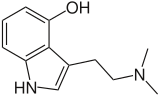
The furnishings of psilocybin mushrooms come from psilocybin and psilocin. When psilocybin is ingested, information technology is cleaved downwards by the liver in a process called dephosphorylation. The resulting compound is chosen psilocin, which is responsible for the psychedelic furnishings.[28] Psilocybin and psilocin create short-term increases in tolerance of users, thus making it difficult to misuse them because the more oftentimes they are taken within a short catamenia of fourth dimension, the weaker the resultant furnishings are.[29] Psilocybin mushrooms take not been known to crusade physical or psychological dependence (addiction).[30] The psychedelic effects tend to appear around 20 minutes after ingestion and tin can last upwardly to half dozen hours. Physical effects including nausea, vomiting, euphoria, muscle weakness or relaxation, drowsiness, and lack of coordination may occur.
As with many psychedelic substances, the effects of psychedelic mushrooms are subjective and can vary considerably amidst private users. The listen-altering furnishings of psilocybin-containing mushrooms typically terminal from 3 to eight hours depending on dosage, grooming method, and personal metabolism. The outset 3–four hours after ingestion are typically referred to as the 'peak'—in which the user experiences more than brilliant visuals and distortions in reality. The furnishings can seem to last much longer to the user because of psilocybin'south ability to alter fourth dimension perception.[31]

Despite risks, mushrooms do much less damage in the U.k. than other recreational drugs.
Sensory [edit]
Sensory effects include visual and auditory hallucinations followed past emotional changes and altered perception of fourth dimension and space.[32] Noticeable changes to the auditory, visual, and tactile senses may go apparent around xxx minutes to an hour after ingestion, although effects may have up to two hours to take place. These shifts in perception visually include enhancement and contrasting of colors, strange calorie-free phenomena (such as auras or "halos" around lite sources), increased visual acuity, surfaces that seem to ripple, shimmer, or exhale; complex open up and airtight eye visuals of form constants or images, objects that warp, morph, or modify solid colours; a sense of melting into the environment, and trails behind moving objects. Sounds may seem to have increased clarity—music, for example, can take on a profound sense of cadency and depth.[32] Some users feel synesthesia, wherein they perceive, for example, a visualization of colour upon hearing a particular sound.[33]
Emotional [edit]
As with other psychedelics such equally LSD, the experience, or 'trip', is strongly dependent upon set up and setting.[32] Hilarity, lack of concentration, and muscular relaxation (including dilated pupils) are all normal effects, sometimes in the same trip.[32] A negative surroundings could contribute to a bad trip, whereas a comfortable and familiar environment would set the phase for a pleasant feel. Psychedelics make experiences more intense, so if a person enters a trip in an broken-hearted state of mind, they will likely experience heightened anxiety on their trip. Many users find it preferable to ingest the mushrooms with friends or people who are familiar with 'tripping'.[34] The psychological consequences of psilocybin use include hallucinations and an inability to discern fantasy from reality. Panic reactions and psychosis also may occur, particularly if a user ingests a big dose. In addition to the risks associated with ingestion of psilocybin, individuals who seek to use psilocybin mushrooms also risk poisoning if one of the many varieties of poisonous mushrooms is confused with a psilocybin mushroom.[35]
Dosage [edit]

A bag of 1.five grams of dried psilocybe cubensis mushrooms.
Dosage of mushrooms containing psilocybin depends on the psilocybin and psilocin content of the mushroom which can vary significantly between and within the same species, only is typically around 0.5–ii.0% of the dried weight of the mushroom. Usual doses of the mutual species Psilocybe cubensis range effectually 1.0 to ii.5 grand,[36] while nearly 2.5 to 5.0 g[36] dried mushroom material is considered a strong dose. Higher up 5 g is ofttimes considered a heavy dose with five.0 grams of dried mushroom oftentimes being referred to equally a "heroic dose".[37] [38]
The concentration of active psilocybin mushroom compounds varies from species to species, but also from mushroom to mushroom within a given species, subspecies or variety. The aforementioned holds true for different parts of the same mushroom. In the species Psilocybe samuiensis, the dried cap of the mushroom contains the most psilocybin at about 0.23%–0.90%. The mycelium contains about 0.24%–0.32%.[39] Drinking a mushroom tea is easier on the stomach than consuming the difficult to digest, raw mushroom material, such every bit chitin which makes up fungi's jail cell walls.[forty]
Research [edit]
Due partly to restrictions of the Controlled Substances Act in the United States, research had been frozen until the early on 21st century when psilocybin mushrooms were tested for their potential to treat drug dependence, feet and mood disorders.[41] In 2018–19, the Food and Drug Assistants (FDA) granted Quantum Therapy Designation for studies of psilocybin in depressive disorders.[42]
A study at Johns Hopkins University found that a dose of 20 to xxx mg psilocybin per 70 kg occasioning mystical-blazon experiences brought lasting positive changes to traits including altruism, gratitude, forgiveness and feeling close to others when information technology was combined with meditation and an all-encompassing spiritual exercise support programme.[43] [44] There is scientific evidence for a context- and land-dependent causal effect of psychedelic apply on connection with nature.[45]
Legality [edit]
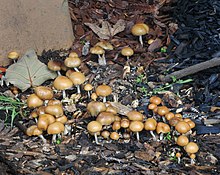
The legality of the cultivation, possession, and sale of psilocybin mushrooms and of psilocybin and psilocin varies from country to land.
See also [edit]
- Magic truffle
- List of psilocybin mushroom species
- List of psychoactive plants, fungi, and animals
- Entheogenic drugs and the archaeological record
- Psychedelic (disambiguation)
- Psilocybin decriminalization in the United States
- Psychonautics
- Mystical psychosis
- Ethnomycology
- Medicinal fungi
- Mushroom tea
- Carlos Castaneda
- Paul Stamets
References [edit]
- ^ Kuhn, Cynthia; Swartzwelder, Scott; Wilson, Wilkie (2003). Buzzed: The Straight Facts about the Most Used and Abused Drugs from Alcohol to Ecstasy. West.W. Norton & Company. p. 83. ISBN978-0-393-32493-8.
- ^ Canada, Wellness (January 12, 2012). "Magic mushrooms – Canada.ca". www.canada.ca. Archived from the original on December 22, 2017. Retrieved December 20, 2017.
- ^ a b c Guzmán 1000. (2008). "Hallucinogenic mushrooms in Mexico: An overview". Economic Botany. 62 (3): 404–412. doi:10.1007/s12231-008-9033-viii. S2CID 22085876.
- ^ Akers, Brian P.; Ruiz, Juan Francisco; Piper, Alan; Ruck, Carl A. P. (2011). "A Prehistoric Mural in Spain Depicting Neurotropic Psilocybe Mushrooms?1". Economic Botany. 65 (2): 121–128. doi:x.1007/s12231-011-9152-5. S2CID 3955222.
- ^ Abuse, National Found on Drug (Apr 22, 2019). "Hallucinogens DrugFacts". National Found on Drug Abuse. Archived from the original on December 26, 2018. Retrieved December 27, 2020.
- ^ F.J. Carod-Artal (January 1, 2015). "Hallucinogenic drugs in pre-Columbian Mesoamerican cultures". Neurología (English language Edition). 30 (1): 42–49. doi:10.1016/j.nrleng.2011.07.010. PMID 21893367.
- ^ a b Stamets (1996), p. xi.
- ^ Stamets (1996), p. vii.
- ^ Hofmann A. (1980). "The Mexican relatives of LSD". LSD: My Problem Child. New York City: McGraw-Hill. pp. 49–71. ISBN978-0-07-029325-0.
- ^ Brande East. (1799). "Mr. E. Brande, on a poisonous species of Agaric". The Medical and Physical Journal: Containing the Primeval Information on Subjects of Medicine, Surgery, Chemist's, Chemical science and Natural History. 3 (11): 41–44. PMC5659401. PMID 30490162.
- ^ Wasson RG (1957). "Seeking the magic mushroom". Life. No. May thirteen. pp. 100–120.
- ^ Heim R. (1957). "Notes préliminaires sur les agarics hallucinogènes du Mexique" [Preliminary notes on the hallucination-producing agarics of Mexico]. Revue de Mycologie (in French). 22 (1): 58–79.
- ^ Hofmann A, Frey A, Ott H, Petrzilka T, Troxler F (1958). "Konstitutionsaufklärung und Synthese von Psilocybin" [The composition and synthesis of psilocybin]. Cellular and Molecular Life Sciences (in High german). 14 (xi): 397–399. doi:10.1007/BF02160424. PMID 13609599. S2CID 33692940.
- ^ Hofmann A, Heim R, Brack A, Kobel H (1958). "Psilocybin, ein psychotroper Wirkstoff aus dem mexikanischen Rauschpilz Psilocybe mexicana Heim" [Psilocybin, a psychotropic drug from the Mexican magic mushroom Psilocybe mexicana Heim]. Experientia (in German). 14 (3): 107–109. doi:10.1007/BF02159243. PMID 13537892. S2CID 42898430.
- ^ "Dr. Leary's Concur Prison Experiment: A 34 Year Follow-Upwardly Study". Bulletin of the Multidisciplinary Association for Psychedelic Studies. ix (4): x–18. 1999. Archived from the original on March 23, 2021. Retrieved March 26, 2021.
- ^ Lattin, Don (2010). The Harvard Psychedelic Club: How Timothy Leary, Ram Dass, Huston Smith, and Andrew Weil killed the fifties and ushered in a new age for America (1st ed.). New York: HarperOne. pp. 37–44. ISBN978-0-06-165593-7.
- ^ Monaghan, John D.; Cohen, Jeffrey H. (2000). "30 years of Oaxacan ethnography". In Monaghan, John; Edmonson, Barbara (eds.). Ethnology. Austin, Texas: Academy of Texas Printing. p. 165. ISBN978-0-292-70881-v.
- ^ a b Guzmán, Thou.; Allen, J.W.; Gartz, J. (2000). "A worldwide geographical distribution of the neurotropic fungi, an assay and discussion" (PDF). Annali del Museo Civico di Rovereto: Sezione Archeologia, Storia, Scienze Naturali. xiv: 189–280. Archived (PDF) from the original on Feb 5, 2018. Retrieved April v, 2022.
- ^ Guzmán Thou, Allen JW, Gartz J (1998). "A worldwide geographical distribution of the neurotropic fungi, an analysis and discussion" (PDF). Annali del Museo Civico di Rovereto. 14: 207. Archived (PDF) from the original on June 26, 2010. Retrieved September 17, 2017.
- ^ a b Guzmán, G. (2005). "Species diversity of the genus Psilocybe (Basidiomycotina, Agaricales, Strophariaceae) in the world mycobiota, with special attention to hallucinogenic backdrop". International Journal of Medicinal Mushrooms. seven (1–2): 305–331. doi:10.1615/intjmedmushr.v7.i12.280.
- ^ Wurst, M.; Kysilka, R.; Flieger, M. (2002). "Psychoactive tryptamines from Basidiomycetes". Folia Microbiologica. 47 (1): iii–27 [5]. doi:ten.1007/BF02818560. PMID 11980266. S2CID 31056807.
- ^ Guzmán, Thousand. (1983). The Genus Psilocybe: A Systematic Revision of the Known Species Including the History, Distribution, and Chemistry of the Hallucinogenic Species. Beihefte Zur Nova Hedwigia. Vol. 74. Vaduz, Liechtenstein: J. Cramer. pp. 361–ii. ISBN978-3-7682-5474-8.
- ^ a b c "Chemic Composition Variability in Magic Mushrooms". March 4, 2019. Archived from the original on August 18, 2021. Retrieved August 17, 2021.
- ^ "Hallucinogenic mushrooms drug profile". European Monitoring Eye for Drugs and Drug Addiction. Archived from the original on August 17, 2021. Retrieved August 17, 2021.
- ^ Blei F, Dörner Southward, Fricke J, Baldeweg F, Trottmann F, Komor A, Meyer F, Hertweck C, Hoffmeister D (January 2020). "Simultaneous Product of Psilocybin and a Cocktail of β-Carboline Monoamine Oxidase Inhibitors in "Magic" Mushrooms". Chemistry—A European Journal. 26 (3): 729–734. doi:x.1002/chem.201904363. PMC7003923. PMID 31729089.
- ^ Krüzselyi D, Vetter J, Ott PG, Darcsi A, Béni Due south, Gömöry Á, Drahos L, Zsila F, Móricz ÁM (September 2019). "Isolation and structural elucidation of a novel brunnein-type antioxidant β-carboline alkaloid from Cyclocybe cylindracea". Fitoterapia. 137: 104180. doi:ten.1016/j.fitote.2019.104180. PMID 31150766. S2CID 172137046.
- ^ Teichert A, Lübken T, Schmidt J, Kuhnt C, Huth M, Porzel A, Wessjohann L, Arnold Due north (2008). "Determination of beta-carboline alkaloids in fruiting bodies of Hygrophorus spp. past liquid chromatography/electrospray ionisation tandem mass spectrometry". Phytochemical Analysis. 19 (four): 335–41. doi:10.1002/pca.1057. PMID 18401852.
- ^ Passie, T.; Seifert, J.; Schneider, und; Emrich, H.Chiliad. (2002). "The pharmacology of psilocybin". Habit Biology. 7 (4): 357–364. doi:10.1080/1355621021000005937. PMID 14578010. S2CID 12656091.
- ^ "Psilocybin Fast Facts". National Drug Intelligence Center. Archived from the original on May 12, 2007. Retrieved Apr four, 2007.
- ^ van Amsterdam, J.; Opperhuizen, A.; van den Brink, W. (2011). "Harm potential of magic mushroom use: A review". Regulatory Toxicology and Pharmacology. 59 (3): 423–429. doi:10.1016/j.yrtph.2011.01.006. PMID 21256914.
- ^ Wittmann, Chiliad.; Carter, O.; Hasler, F.; Cahn, B.R.; Grimberg, und; Spring, P.; Hell, D.; Flohr, H.; Vollenweider, F.X. (2007). "Furnishings of psilocybin on fourth dimension perception and temporal control of behaviour in humans". Journal of Psychopharmacology. 21 (1): l–64. doi:10.1177/0269881106065859. PMID 16714323. S2CID 3165579.
- ^ a b c d Schultes, Richard Evans (1976). Hallucinogenic Plants. Illustrated by Elmer W. Smith. New York: Gilt Press. p. 68. ISBN978-0-307-24362-1.
- ^ Ballesteros, S.; Ramón, One thousand.F.; Iturralde, G.J.; Martínez-Arrieta, R. (2006). "Natural Sources of Drugs of Abuse: Magic Mushrooms". In Cole, S.M. (ed.). New Inquiry on Street Drugs. Nova Scientific discipline Publishers. p. 175. ISBN978-ane-59454-961-8.
- ^ Stamets (1996)
- ^ "Psilocybin Fast Facts". National Drug Intelligence Center, US Section of Justice. Archived from the original on May three, 2018. Retrieved May 3, 2018.
 This article incorporates text from this source, which is in the public domain .
 - ^ a b Erowid (2006). "Dosage Chart for Psychedelic Mushrooms" (shtml). Erowid. Archived from the original on April 18, 2007. Retrieved Dec 1, 2006.
- ^ "Terence McKenna'due south Last Trip". Wired Magazine. Condé Nast Publications. May 1, 2000. Archived from the original on March 14, 2014. Retrieved September 17, 2017.
- ^ Jesso, James W. (June 13, 2013). Decomposing The Shadow: Lessons From The Psilocybin Mushroom. SoulsLantern Publishing. p. 90. ISBN978-0-9919435-0-0.
- ^ Gartz J, Allen JW, Merlin Md (2004). "Ethnomycology, biochemistry, and cultivation of Psilocybe samuiensis Guzmán, Bandala and Allen, a new psychoactive mucus from Koh Samui, Thailand". Journal of Ethnopharmacology. 43 (two): 73–80. doi:10.1016/0378-8741(94)90006-X. PMID 7967658.
- ^ Janikian, Michelle (November 4, 2021). "How to Make Shroom Tea: The Ultimate Mushroom Tea Guide". DoubleBlind Mag. Archived from the original on January 6, 2022. Retrieved January half dozen, 2022.
- ^ Bui, Eric; King, Franklin; Melaragno, Andrew (December 1, 2019). "Pharmacotherapy of anxiety disorders in the 21st century: A telephone call for novel approaches (Review)". General Psychiatry. 32 (6): e100136. doi:ten.1136/gpsych-2019-100136. PMC6936967. PMID 31922087.
- ^ "FDA grants Breakthrough Therapy Designation to Usona Institute's psilocybin program for major depressive disorder". www.businesswire.com. November 22, 2019. Archived from the original on October 26, 2021. Retrieved September 17, 2020.
- ^ Griffiths, Roland R.; et al. (October 2017). "Psilocybin-occasioned mystical-blazon experience in combination with meditation and other spiritual practices produces indelible positive changes in psychological functioning and in trait measures of prosocial attitudes and behaviors". Journal of Psychopharmacology. 32 (ane): 49–69. doi:x.1177/0269881117731279. PMC5772431. PMID 29020861.
- ^ "Psilocybin (from magic mushrooms) plus meditation and spiritual training leads to lasting changes in positive traits". Research Assimilate. Jan nineteen, 2018. Archived from the original on February 21, 2019. Retrieved Feb 21, 2019.
- ^ Kettner, Hannes; Gandy, Sam; Haijen, Eline C. H. M.; Carhart-Harris, Robin L. (December xvi, 2019). "From Egoism to Ecoism: Psychedelics Increase Nature Relatedness in a State-Mediated and Context-Dependent Manner". International Journal of Environmental Research and Public Health. 16 (24): 5147. doi:10.3390/ijerph16245147. PMC6949937. PMID 31888300.
Bibliography [edit]
- Allen, J.W. (1997). Magic Mushrooms of the Pacific Northwest. Seattle: Raver Books and John West. Allen. ISBN978-1-58214-026-1.
- Estrada, A. (1981). Maria Sabina: Her Life and Chants. Ross Erikson. ISBN978-0-915520-32-9.
- Haze, Virginia & Dr. 1000. Mandrake, PhD. The Psilocybin Mushroom Bible: The Definitive Guide to Growing and Using Magic Mushrooms. Greenish Candy Press: Toronto, Canada, 2016. ISBN 978-1-937866-28-0. www.greencandypress.com.
- Högberg, O. (2003). Flugsvampen och människan (in Swedish). ISBN978-91-7203-555-three.
- Kuhn, C.; Swartzwelder, S; Wilson, West. (2003). Buzzed: The Straight Facts about the Nigh Used and Abused Drugs from Alcohol to Ecstasy . New York: W.W. Norton & Visitor. ISBN978-0-393-32493-eight.
- Letcher, A. (2006). Shroom: A Cultural History of the Magic Mushroom. London: Faber and Faber. ISBN978-0-571-22770-nine.
- McKenna, T. (1993). Nutrient of the Gods. Bantam. ISBN978-0-553-37130-7.
- Nicholas, 50.G.; Ogame, M. (2006). Psilocybin Mushroom Handbook: Easy Indoor and Outdoor Cultivation. Quick American Archives. ISBN978-0-932551-71-9.
- Stamets, P. (1993). Growing Gourmet and Medicinal Mushrooms. Berkeley: Ten Speed Printing. ISBN978-ane-58008-175-7.
- Stamets, P.; Chilton, J.S. (1983). The Mushroom Cultivator. Olympia: Agarikon Press. ISBN978-0-9610798-0-2.
- Stamets, P. (1996). Psilocybin Mushrooms of the Globe. Berkeley: 10 Speed Press. ISBN978-0-9610798-0-two.
- Wasson, Grand.R. (1980). The Wondrous Mushroom: Mycolatry in Mesoamerica. McGraw-Hill. ISBN978-0-07-068443-0.
External links [edit]
 The dictionary definition of magic mushroom at Wiktionary
Source: https://en.wikipedia.org/wiki/Psilocybin_mushroom
0 Response to "Harm Potential of Magic Mushroom Use a Review Summary"
Post a Comment